
Sullivan County Release Date Meaning
A sentence date is not always a day when a person walks out. The Missouri Department of Corrections maintains several legal milestones. Its documented data layout includes a Sentence Minimum Release Date and a Sentence Maximum Release Date. A minimum date can concern eligibility for a form of release. A maximum date concerns the end point of a sentence row, subject to the record's terms and special codes. Neither should be silently renamed “projected” or “tentative.” The live offender search is session dependent, and the research did not verify a public field with either of those exact labels.
The actual Sullivan County release date is the physical custody event. For a person held on a local case, the jail record should show the exit time, release reason, authority, and destination. The court file explains the order behind that event. For a state prisoner, MODOC calculates the sentence and records the status. A date can lead to parole or conditional release, which means the person leaves prison but remains under state authority. Final discharge is different because the sentence or supervision term has ended.
Find Sullivan County Projected Dates
Start with the custody path, not a percentage formula. Sullivan County has a holding point in Milan, and secondary reporting describes transfers to the Daviess/DeKalb Regional Jail. That transfer practice must be confirmed for the individual booking. A person committed to MODOC moves into a different records system. Someone held before trial may leave after bond or a court order, but another warrant or detainer can still prevent a community release.
- Identify the case and agency. Use the full name, case or booking number, approximate booking date, and DOC number when one exists.
- Check current custody. Ask the Sullivan County Sheriff's Office or regional jail whether the person is held now. A missing name alone does not prove release.
- Read the court order. Search Missouri Case.net for the Sullivan County judgment, bond order, sentence, amended order, or later docket entry.
- Use the state channel when needed. Search the MODOC Offender Web Search for a person committed to state custody or under active state supervision.
- Request the calculation. Ask the jail for a county sentence calculation or MODOC for its sentence fields. Do not calculate a personal date from the headline sentence.
- Confirm the event. Obtain the release entry, discharge record, or supervision record after the expected milestone passes.
The broader Sullivan County released-inmate search path explains how to match a local release record to the court disposition. That match is vital when one agency's roster no longer shows the name.
Note: Court entries can support a release order, but the custodial record supplies the exact exit time and receiving authority.
Sullivan County MODOC Release Fields
The interactive offender search covers active prison custody and active MODOC supervision. It is not a Sullivan County jail archive, and its welcome screen excludes discharged offenders. Use a DOC number when possible. Otherwise, compare the legal name or documented alias with identity facts, offense, sentence county, assignment, and supervision data. Open the detail record rather than relying on a name-results grid.
MODOC's official Sunshine Law data documentation is especially useful because it defines archival fields rather than asking a reader to guess at portal labels. A sentence can create more than one row. Concurrent and consecutive matters, different offenses, and separate case numbers may therefore display different dates.
The nightly archive described by MODOC can include the DOC ID, name, birth date, assigned place, case or cause number, sentence county, offense, sentence date, minimum and maximum release fields, a completed flag, and probation information. Data reaches back as early as 1974, subject to conversion limits, while the current information system dates from 1998. Those dates describe database coverage, not a promise that every old field is complete. Several rows can belong to one person. Match each row to the Sullivan County case and check whether every active sentence has ended.
| Documented field | How to read it |
|---|---|
| DOC ID | Use it to distinguish people with similar names and to frame a records request. |
| Case or cause number | Match it to the Sullivan County court file and the correct sentence. |
| Sentence Minimum Release Date | Treat it as the agency's named sentence field, not a promise of physical release. |
| Sentence Maximum Release Date | Review the row and any special code before treating the value as a calendar date. |
| Sentence completed flag | It applies to that sentence row and does not prove every matter has ended. |
| Assignment or supervision | It can show prison placement or active community supervision rather than final discharge. |
The MODOC Sunshine Law data page is the source for those minimum and maximum sentence fields.
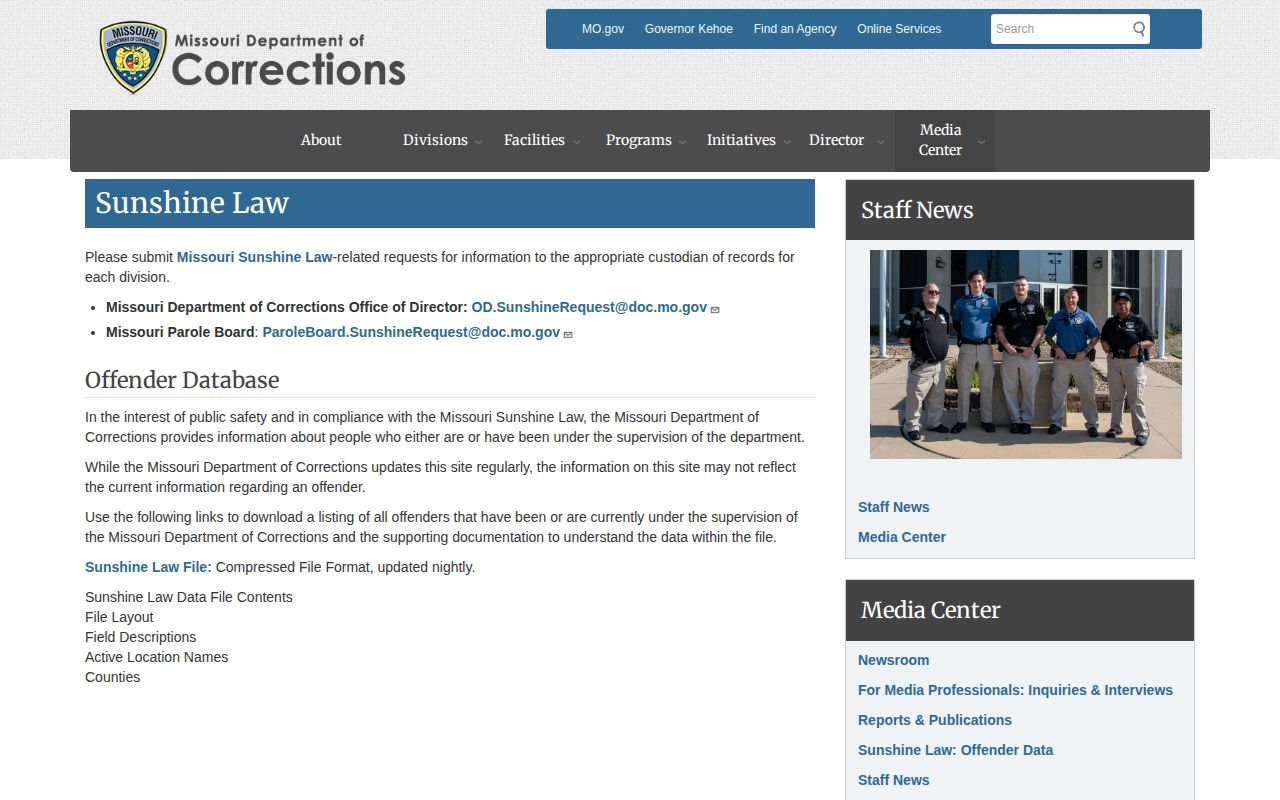
The capture documents the official field vocabulary, which is safer than applying a generic “projected date” label to every value.
Sullivan County Conditional Release
Missouri section 558.011 divides many term-of-years felony sentences into a prison term and a conditional-release term, subject to statutory exclusions. For a term of nine years or less, the conditional part is one-third. For a term greater than nine through fifteen years, it is three years. For a term over fifteen years, it is five years. The prison term is the balance. These rules describe a legal framework, not a do-it-yourself date calculator.
Conditional release is a conditional discharge by the Parole Board under Probation and Parole supervision. It differs from discretionary parole eligibility. The Board may extend a conditional-release date up to the full sentence after a violation and hearing. Treatment requirements and other lawful factors can also affect the practical date. Thus, the date on one sentence row must be read with the current status, Board action, and all other active rows.
A pretrial Sullivan County detainee does not fit this state-sentence formula. The next event can turn on bond, a dismissal, a plea, a judgment, or a hold from another body. Even a signed release order may be followed by processing time or delivery to another warrant. The Sullivan Sheriff or regional jail should confirm the physical event. Case.net supplies the judicial reason, but it cannot replace the custody timestamp.
- Parole
- Discretionary community release approved by the Parole Board before sentence completion.
- Conditional release
- A statutory supervised portion of many prison sentences.
- Discharge
- The end of the relevant sentence or supervision term, not just departure from prison.
- Detainer
- A request or legal hold from another authority that can change the destination at release.
Sullivan County Release Percentage Rules
The often-repeated 85 percent figure is not a universal Missouri rule. Section 558.019 sets specified minimum prison terms for certain cases. Under the statute described in the research, some repeat non-dangerous-felony commitments use 40 percent after one prior commitment, 50 percent after two, and 80 percent after three or more, subject to the current law's exceptions. A dangerous felony as defined by section 556.061 generally carries an 85 percent minimum or the statute's age-based alternative.
A minimum prison term concerns eligibility for parole, conditional release, or another early MODOC release. It does not require release on the eligibility date. The offense, sentence date, prior commitments, statutory definition, Board authority, and other active sentences all matter. Life and very long aggregate terms also receive special treatment within the statute. Only the current judgment and an official MODOC calculation can resolve a specific case.
Note: Eligibility and release are separate decisions, so an official minimum date may pass while lawful custody or supervision continues.
Sullivan County Credits and Discharge
The official sources do not support a claim that generic Missouri prison “good time” automatically cuts every sentence. The verified earned compliance credit in section 217.703 concerns eligible people on probation, parole, or conditional-release supervision. The key distinction is firm: these are community-supervision credits, not a general prison good-time award.
Eligible compliance credit can accelerate final discharge from community supervision. It does not rewrite the day a person first leaves prison, and it does not establish that every supervised person qualifies. Violation reports, custody, court motions, or absconder status may interrupt credit. A court or the Parole Board retains the relevant discharge authority. Calculation questions belong with the assigned officer or MODOC records staff.
A county jail term follows another path. Ask the Sullivan County holding facility or the regional jail for the computation it actually used, and compare that answer with the Sullivan County court commitment. No verified local weekend-release rule, local good-time schedule, or public calculation policy was found. Silence in the online record is not permission to assume one.
When the public portal is insufficient, a focused records request should name the person, DOC number, case, and exact sentence row. Ask for the minimum and maximum release fields, completed indicator, later corrections, and final discharge record. For a local term, ask for the commitment, credit applied, calculated end date, actual release time, and destination. These records answer different parts of the same question.
Why Sullivan County Dates Change
Release-related dates move for many record-based reasons. Some changes come from a court. Others come from MODOC sentence administration or Parole Board action. A new hold may not change the end of the Sullivan case, yet it can change whether the person goes home. That is why the destination and receiving agency belong in the final release record.
| Factor | Possible effect | Confirm with |
|---|---|---|
| Amended judgment or jail credit | Changes the time calculation or sentence basis. | Case.net, court clerk, and calculating agency |
| Concurrent or consecutive sentences | Changes how multiple terms overlap or follow one another. | MODOC sentence record and judgments |
| Board decision | May grant, deny, defer, or set terms for parole. | Missouri Parole Board |
| Conditional-release violation | Can extend the conditional date toward the full sentence. | Board and Probation and Parole |
| Detainer or other warrant | May cause transfer instead of community release. | Releasing and receiving agencies |
| Data correction | Repairs a field without changing the underlying lawful sentence. | MODOC records or the source agency |
For state questions, send a narrow request through MODOC open records. For local cases, the Sullivan Sheriff record and court file should be read together. If a future custody-change alert would help, the Sullivan County VINELink check explains the separate notification route and its limits.